Identity & Self-Trust
How to Figure Out What You Actually Want in Life
“What do you want?” sounds like an easy question until you try to answer it without considering what makes sense, what you can afford, what others expect, or what you've always said you wanted.
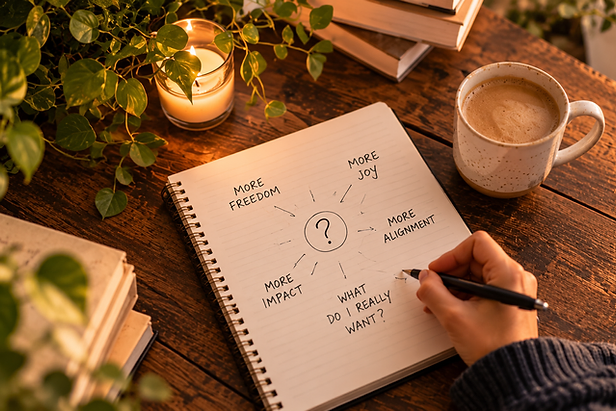
For capable women, the answer can come quickly: a thriving business, financial independence, more freedom, a happy family, meaningful work. Those may all be true. But they may not be the whole answer.
If you're trying to figure out what you actually want in life, you may not need a better five-year plan. You may need room to hear yourself before turning every desire into a strategy.
Why it's surprisingly hard to know what you want
We learn to make choices inside real circumstances. Family responsibilities matter. Money matters. Relationships matter. Practicality isn't the enemy of authenticity.
But over time, it can become difficult to tell the difference between what you've chosen and what you've become skilled at accommodating. You might say yes because you can handle it. You might pursue a goal because you have the ability to reach it. You might keep a role because everyone relies on you in it.
None of that proves the choice was wrong. It simply makes curiosity important.
Start with your first answer and then finish it
Try asking yourself: What do I want from my work right now?
Maybe your first answer is, “I want to grow.” Now add a second sentence: “I want to grow, but…”
Perhaps it becomes: “I want to grow, but I don't want to manage a large team.” Or: “I want to grow, but I don't want to spend every evening working.” Or even: “I say I want to grow, but I'm not sure why anymore.”
That second sentence isn't automatically more truthful than the first. It's an invitation to make your answer more complete.
Repeat this with money, family, relationships, time, and the way you want your ordinary Tuesday to feel. The ordinary day matters. A dream that only sounds appealing at the finish line deserves a closer look.
Separate desire from obligation
Take a page and create three columns: I want, I should, and I'm not sure.
Write freely. “I want a slower morning.” “I should grow the company.” “I'm not sure whether I want to move.” Avoid sorting everything into a final decision. The third column is important: uncertainty is not failure.
Then revisit each “should.” Ask: Who says? What happens if I don't? Is there any part of this I would still choose?
You may find that some obligations reflect your deepest values. Others may be outdated. Both discoveries are useful.
Pay attention to energy without treating it as an oracle
Notice what leaves you feeling engaged, spacious, resentful, relieved, or depleted. These reactions are clues, not commands. Something meaningful can be difficult. Something comfortable can keep you from a choice you care about.
Instead of asking only “Does this feel good?”, ask: “Does this feel worth it to me?” and “What would need to change for this to fit my life better?”
You are allowed to choose experimentally
Knowing what you want doesn't always arrive as a dramatic revelation. Sometimes you learn by testing smaller choices: declining one obligation, restructuring one workday, having one honest conversation, or giving an interest time without monetizing it.
You don't need to declare a permanent new identity to make a different choice this month.
A question to carry with you
If you didn't have to defend your answer, what would you admit you want more of? And what would you admit you want less of?
Let the answers be imperfect. Let them change.
The Second Sentence is an eight-part, self-guided experience with audio lessons, reflection, and a companion workbook for exploring what sits beneath your familiar answers. If you'd rather begin with a free check-in, start with Is It Actually Yours?.
Your next step
A self-guided reflection experience for what sits beneath your familiar answers.
Where to Go From Here
Something here stayed with you?
Maybe something you read made you question an assumption, recognize a familiar pattern, or think differently about what you want.
You don't have to figure out what it means all at once. But if you'd like to explore a little further, there are a couple of places you can begin.
A Place to Begin · Free
Is It Actually Yours?
How much of what you want, believe, and pursue genuinely belongs to you?
This free assessment invites you to look a little closer at the expectations, assumptions, and choices shaping your life.
You don't need to know what you're looking for. Just bring a little curiosity.
Go a Little Deeper · Self-Guided
The Second Sentence
You've probably told yourself certain stories about who you are, what you're capable of, and what's possible for you.
But what happens when you look beyond the familiar first sentence?
Explore an eight-part guided audio and workbook experience designed to help you question old narratives, understand what's shaping your choices, and discover what else might be true.
"There's no right place to begin. Only the one that feels useful to you."