Identity & Self-Trust
Why You Feel Like You're Never Doing Enough
You finish the task, hit the milestone, solve the problem and almost immediately notice what still isn't done.

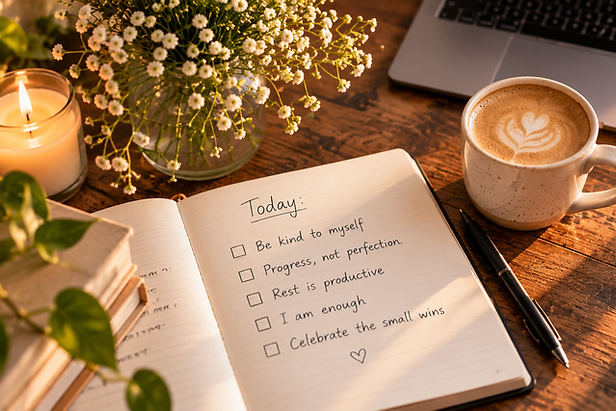
You could list everything you accomplished today and still go to bed thinking you should have done more.
If that sounds familiar, the question may not be how to become more productive. It may be who decided what enough was supposed to look like in the first place.
The finish line that keeps moving
Ambition can be energizing. It gives direction and momentum. But when accomplishment becomes the primary way you measure your worth or safety, there may never be a natural point at which you feel finished.
A growing business creates new opportunities and new responsibilities. A promotion introduces a higher standard. A day of rest can feel like a day you failed to use.
Sometimes you're responding to real demands. Sometimes you're also carrying expectations that no one has clearly defined, including yourself.
Separate the work from the story
Imagine saying, “I didn't finish everything on my list today.” That's an observation.
Now notice the story that might follow: “I'm falling behind. I should be able to handle more. Other women are doing so much better.”
The observation may be accurate. The story deserves examination.
Try asking: “What specifically remains unfinished?” and “What does that unfinished work actually mean?” You may discover a practical scheduling problem. Or you may notice that a normal limitation has become a judgment about who you are.
Enough isn't the same as giving up
Choosing an end to the workday doesn't mean you lack drive. Deciding not to pursue every opportunity doesn't mean you're afraid of success. You can be deeply committed to your goals while deciding that your time, health, relationships, and attention also belong in the equation.
The goal isn't to convince yourself you never need to grow. It's to stop treating every quiet moment as evidence that you should be doing more.
A practical exercise: name the invisible rule
When you hear “I should be doing more,” finish these prompts:
- “If I don't do more, I'm afraid…”
- “The standard I'm comparing myself to is…”
- “If someone I loved had done what I did today, I'd tell her…”
- “One thing I can let be enough for today is…”
You don't need to believe every reassuring answer immediately. You can simply notice where your standards are harsher than you realized.
Make room for a more complete definition of progress
Some progress is visible: revenue, completed projects, published work. Other progress is quieter: making a decision that fits, protecting an important relationship, declining a misaligned opportunity, or giving yourself permission to change course.
You get to decide which forms of progress matter in the life you're building.
The Second Sentence helps you explore the beliefs and familiar answers beneath patterns like “I should be doing more.” You can also subscribe to Hers in the Making below for reflections that invite better questions, not more pressure.
Your next step
A self-guided reflection experience for what sits beneath your familiar answers.
Where to Go From Here
Something here stayed with you?
Maybe something you read made you question an assumption, recognize a familiar pattern, or think differently about what you want.
You don't have to figure out what it means all at once. But if you'd like to explore a little further, there are a couple of places you can begin.
A Place to Begin · Free
Is It Actually Yours?
How much of what you want, believe, and pursue genuinely belongs to you?
This free assessment invites you to look a little closer at the expectations, assumptions, and choices shaping your life.
You don't need to know what you're looking for. Just bring a little curiosity.
Go a Little Deeper · Self-Guided
The Second Sentence
You've probably told yourself certain stories about who you are, what you're capable of, and what's possible for you.
But what happens when you look beyond the familiar first sentence?
Explore an eight-part guided audio and workbook experience designed to help you question old narratives, understand what's shaping your choices, and discover what else might be true.
"There's no right place to begin. Only the one that feels useful to you."